
Shopping for the best dashcam with Starvis 2 sensor means wading through spec sheets full of resolution numbers, sensor names, and marketing terms that all sound impressive and mean very little on their own. Every listing claims “4K,” every listing claims “night vision,” and most buyers end up picking based on price or star rating without actually understanding what’s different between a camera that performs and one that just looks good on paper.
This guide cuts through that two ways. First, it breaks down dashcam picks by actual use case, daily commuting, rideshare driving, night-heavy driving, and tight budgets, rather than one generic “best overall” list that doesn’t match how differently people actually use these cameras. Second, it gives a straight answer to a question that comes up constantly: is Sony STARVIS 2 really the best dashcam sensor, or is that just the loudest marketing term in the category right now?
Why the Best Dashcam with Starvis 2 Sensor Beats Most 4K Cameras
Before getting into specific models, this single concept will save you from the most common buying mistake in this category: assuming a higher resolution number automatically means better footage.
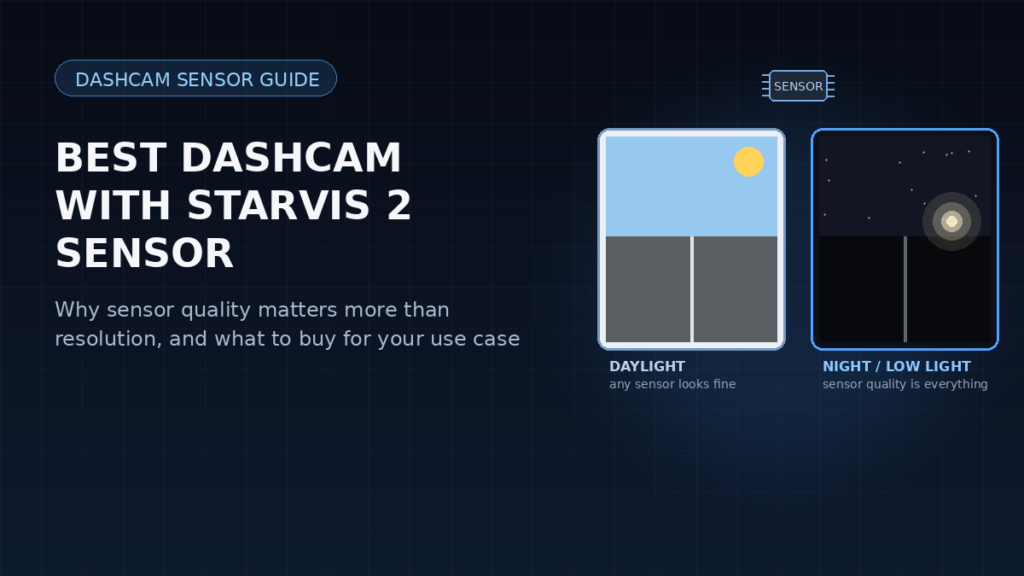
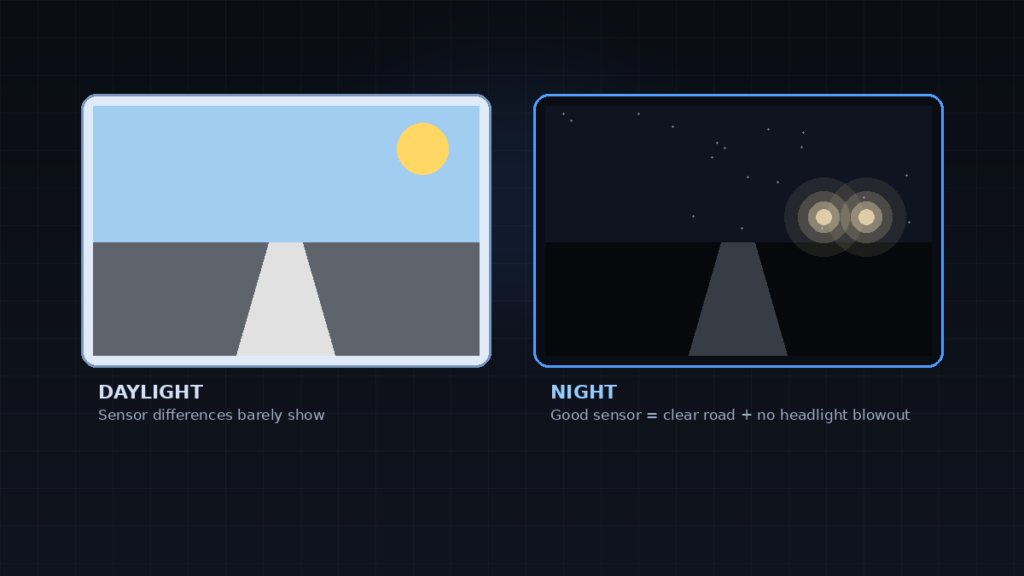
It doesn’t, and the reason comes down to physics rather than marketing. A camera’s resolution determines how many pixels make up each frame. The image sensor determines how much actual light each of those pixels can capture. In good daylight, this difference barely matters, both a strong 2K camera and a weak 4K camera will look perfectly usable. The moment light gets difficult, dusk, rain, unlit roads, oncoming headlights at night, that difference becomes the entire story. A 4K camera with a mediocre sensor will often produce footage that’s technically higher resolution but actually less useful than a 2K camera with a genuinely good sensor, because the 4K footage ends up dark, grainy, and noisy in exactly the conditions where you’re most likely to need it for an actual incident.
This is why sensor quality, not the resolution number on the box, is the single most important spec to understand before comparing any dashcam models.
Is Sony STARVIS 2 Actually the Best Sensor?
Short answer: for most buyers, yes, it’s currently the strongest mainstream choice and the safest default recommendation. But “best” depends on what you’re optimizing for, and there are real alternatives worth knowing about rather than treating STARVIS 2 as the only name that matters.
What STARVIS 2 actually is. It’s the second generation of Sony’s back-illuminated CMOS sensor design, built specifically for low-light and security-style recording. The technical difference from older sensors is straightforward: a back-illuminated structure positions the light-sensitive layer at the front of the chip rather than behind a layer of wiring, which means significantly more light reaches each pixel. Sony rates STARVIS 2 sensors at roughly 2000 mV sensitivity or higher, compared to around 700 mV for standard sensors, which translates to genuinely usable footage in light levels that would look near-black on older hardware.
Where it actually wins. Dusk, dawn, rain, unlit roads, and parking structures are exactly where most disputed incidents happen, and exactly where STARVIS 2’s dynamic range advantage shows up most clearly. It handles the classic hard scenario for any dashcam sensor well: a dark road, a bright sky, and oncoming headlights all in the same frame, without blowing out the highlights or losing the shadows entirely. Color accuracy in low light is also genuinely better, which matters more than people expect since correctly identifying a vehicle’s color in a claim or dispute has real evidentiary value.
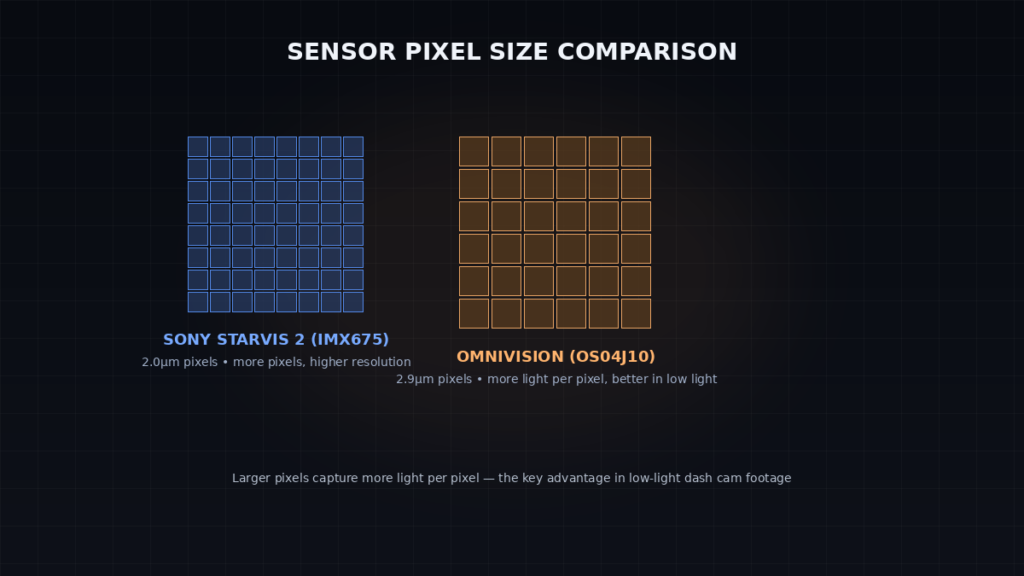
Where the real alternative comes in. OmniVision’s OS04J10 sensor, in particular, is a legitimate competitor rather than a budget compromise. It uses a larger individual pixel size, 2.9 micrometers compared to roughly 2.0 micrometers on Sony’s IMX675, and in low-light, larger pixels matter more than higher pixel count, since each pixel is physically capturing more light. Independent road testing comparing the two sensors found the OmniVision option performing especially well specifically for rear and parking-facing cameras in nighttime and backlit conditions, while Sony’s sensor remained stronger for high-frame-rate daytime capture and HDR handling on the front camera. Several manufacturers, including at least one major rideshare-focused brand, have deliberately chosen OmniVision sensors for their rear camera modules for exactly this reason, while keeping Sony STARVIS 2 on the front.
What to actually avoid. Generic, unbranded CMOS sensors and lesser-known names like base-tier GalaxyCore or SmartSens chips, commonly found in the cheapest budget cameras, are genuinely behind both Sony and OmniVision’s better offerings. These are fine in good daylight but fall apart noticeably at night, producing the grainy, washed-out footage that makes a recorded incident essentially useless as evidence. If a listing doesn’t name a specific sensor at all and only uses vague phrases like “enhanced night vision” or “AI low-light mode,” that’s usually a sign it’s using one of these weaker, unbranded sensors with software processing trying to compensate.
The practical takeaway: Sony STARVIS 2 remains the safest, most broadly excellent default choice, and the right pick if you’re buying one camera that needs to perform well across daytime, nighttime, and front-facing duty. OmniVision’s larger-pixel sensors are a legitimately strong alternative specifically worth seeking out for rear or parking-mode cameras where nighttime and backlit performance matter most. Either is a meaningfully better choice than an unnamed generic sensor, regardless of what resolution number is printed next to it.
Best Dashcam for Daily Commuting
If you’re driving a fairly normal daily routine, work commute, errands, the occasional road trip, you don’t need rideshare-grade multi-channel coverage or extreme parking mode endurance. What you need is reliable image quality and a setup you can install once and forget about.
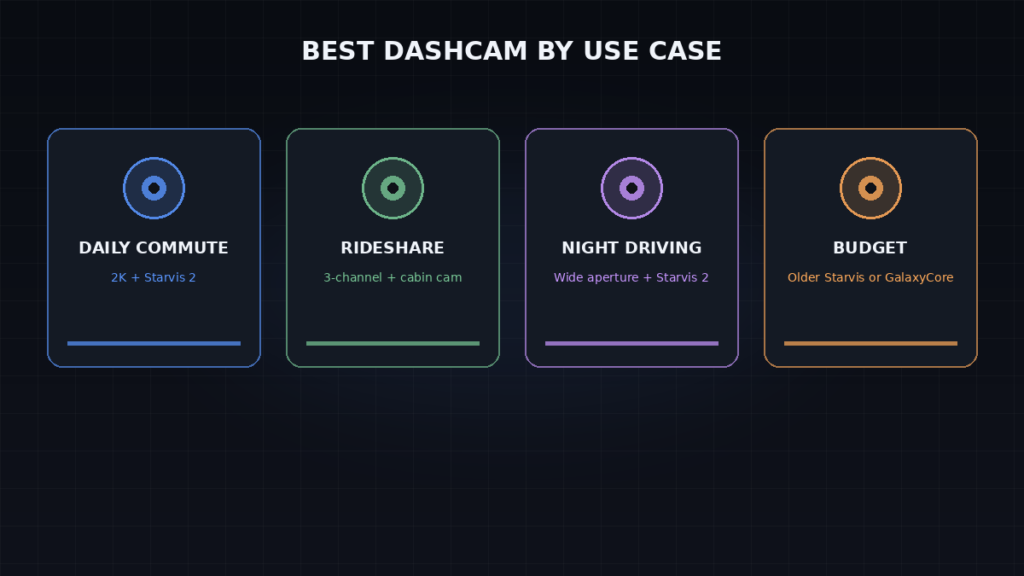
A compact single-channel camera using a Sony STARVIS 2 sensor at 2K resolution is the practical sweet spot here. This combination consistently outperforms budget 4K cameras using lesser sensors, particularly for the early morning and evening light conditions that make up a meaningful chunk of any commute. Look specifically for HDR support alongside the STARVIS 2 sensor, since HDR is what actually manages the bright-sky-versus-dark-road problem in real driving conditions, rather than the sensor working alone.
For most daily commuters, a discreet, wedge-shaped single-channel camera that sits unobtrusively behind your rearview mirror, paired with this sensor tier, delivers genuinely excellent results without paying for multi-camera coverage you’ll rarely need.
Best Dashcam for Rideshare and Passenger Vehicles
Rideshare driving has fundamentally different requirements from personal commuting, and this is where a lot of buyers genuinely overspend on the wrong features or underspend on the one that actually matters.
The single most important feature for rideshare specifically is interior cabin recording, not front camera resolution. The incidents that actually threaten a rideshare driver’s account standing, false harassment accusations, route disputes, property damage claims, almost always involve what happened inside the vehicle, not what happened on the road. A 3-channel setup, front, interior, and rear, recording simultaneously is the realistic minimum for genuine protection, and this is reflected clearly in how rideshare-focused guides and driver communities consistently prioritize interior coverage above all else.
For the interior channel specifically, look for genuine infrared night vision rather than just a low-light-rated lens, since most passenger interactions worth documenting happen after dark, airport runs, bar close, early morning shifts, when ambient cabin lighting is minimal to nonexistent. A front camera using Sony STARVIS 2 at 4K is worth prioritizing if your budget allows it, since rideshare driving accumulates miles fast and a sharper front camera means clearer plate capture if you’re ever in a road incident, not just a passenger dispute.
If your vehicle is a larger multi-row SUV or van, a four-channel setup with dual interior cameras, rather than a single interior lens, is worth the extra cost specifically to avoid missing passengers seated in the far back row.
Best Dashcam for Night-Heavy Driving
If a meaningful portion of your driving happens after dark, late shifts, rural commuting with no streetlights, frequent highway driving at night, this is the use case where sensor choice matters more than literally any other spec on the page.
Prioritize a camera explicitly listing Sony STARVIS 2 across both front and rear channels if you’re running a dual-camera setup, since both directions benefit equally from better low-light performance. If you’re specifically choosing between two otherwise similar cameras and one offers a larger-pixel OmniVision sensor specifically on the rear channel, that’s a legitimate reason to lean toward it rather than assuming Sony is automatically superior in every position.
A wide aperture lens, look for an f/1.8 rating or lower (numerically lower means more light reaches the sensor), paired with the right sensor compounds the night performance advantage further. Resolution matters less here than people assume; a 2K camera with genuinely excellent low-light sensor performance will frequently outperform a 4K camera with a mediocre one once the sun goes down.
Best Budget Dashcam
Budget dashcams have improved significantly, and you no longer need to accept genuinely poor night performance just because you’re working with a smaller budget, though the sensor compromise at this tier is real and worth understanding rather than ignoring.
At lower price points, you’ll commonly see cameras using GalaxyCore sensors instead of Sony or OmniVision options specifically as a cost-saving measure. These produce acceptable, usable daytime footage and genuinely struggle more in low light and HDR-demanding scenes compared to the sensor tiers covered above. This is a real, honest trade-off rather than a dealbreaker, if your primary use case is basic accident documentation in normal daylight conditions and you’re not relying heavily on nighttime footage clarity, a budget camera with a lesser sensor is still considerably better protection than no camera at all.
If you can stretch your budget even slightly, an older-generation single-channel camera using the original Sony STARVIS sensor, the predecessor to STARVIS 2, often costs noticeably less than current STARVIS 2 models while still meaningfully outperforming generic unbranded sensors in low light. This is frequently the smartest value position in the entire category: not the newest sensor, but a genuinely good one at a discount because it’s no longer the current flagship generation.
A Quick Buying Framework
Regardless of which use case matches you, work through these questions in order before looking at specific models: How much of your driving happens in genuinely difficult light, dusk, night, rain, versus daylight? This determines how much sensor quality should weigh in your decision. Do you need interior cabin coverage specifically, or just road-facing documentation? This determines whether you need a 2-channel or 3-channel system. How are you parking, street parking exposed to break-in risk, or a private garage with no real parking risk? This determines whether parking mode endurance and hardwire setup matter to your specific situation. What’s your realistic budget ceiling, and are you willing to accept a slightly older sensor generation to stay within it?
Answering these honestly before comparing specific models prevents the single most common dashcam buying mistake: paying for resolution and brand name recognition while overlooking the sensor quality that actually determines whether your footage is useful when you genuinely need it.
The Bottom Line
Sony STARVIS 2 remains the strongest, safest default sensor choice across most dashcam use cases in 2026, and if you’re buying one camera and want it to simply perform well in nearly every condition, prioritizing this sensor over chasing the highest resolution number is the right call. That said, it isn’t the only legitimate option. OmniVision’s larger-pixel sensors are a real, deliberate choice many manufacturers make specifically for rear and parking-facing cameras, and an older-generation original STARVIS sensor at a lower price point is frequently smarter value than people assume.
What matters most isn’t memorizing sensor model numbers, it’s matching your camera setup, channel count, and sensor priority to how you actually drive, rather than buying whatever spec sheet has the biggest number printed on it. If you’re still narrowing down specific models, [LINK: check our dashcam troubleshooting guide] to understand the storage and settings side of getting reliable footage once you’ve picked your camera.
FAQ — Best Dashcam with Starvis 2 Sensor
Is Sony STARVIS 2 the best dashcam sensor in 2026?
For most buyers, yes, it’s the strongest mainstream, broadly excellent default, with genuinely better dynamic range and low-light sensitivity than older Sony sensors and most unbranded alternatives. It isn’t the only legitimate option, though. OmniVision’s larger-pixel sensors are a real competitor specifically for rear and parking-facing cameras in low light.
Is 4K or 2K better for a dashcam?
Resolution matters less than sensor quality. A 2K camera with a genuinely good sensor like STARVIS 2 will often outperform a 4K camera using a weaker sensor, especially at night, since a higher resolution number doesn’t fix poor light sensitivity. The ideal combination is 4K resolution paired with a STARVIS 2 or equivalent sensor, not 4K alone.
What’s the difference between Sony STARVIS 2 and OmniVision sensors?
Sony STARVIS 2 uses a back-illuminated design that performs strongly across daytime HDR, high frame rate capture, and low light. OmniVision’s OS04J10 uses a larger individual pixel size, which gives it an edge specifically in nighttime and backlit conditions, making it a popular choice for rear or parking-mode cameras even when the front camera uses a Sony sensor.
Do I need an interior camera for rideshare driving?
Yes, if you’re driving for Uber, Lyft, or similar platforms. Most passenger-related disputes, harassment accusations, property damage claims, route disagreements, involve what happened inside the vehicle, not on the road. A 3-channel setup with front, interior, and rear coverage is the realistic minimum for genuine protection.
Is a budget dashcam with a GalaxyCore sensor worth buying?
Yes, with realistic expectations. GalaxyCore and similar budget-tier sensors produce acceptable daylight footage but struggle more in low light compared to Sony or OmniVision options. If your driving is mostly in daylight and your budget is tight, this is still meaningfully better protection than no camera at all.
How do I know what sensor my dashcam actually has?
Check the product listing or spec sheet for an explicit sensor name, such as Sony STARVIS 2 or a specific IMX part number like IMX675 or IMX678. Be cautious of vague marketing terms like “enhanced night vision” or “AI low-light mode” without a named sensor, since these often indicate a weaker, unbranded sensor relying on software processing instead.