
The $100 Device That Could Save You Thousands
There are very few things you can buy for your car that genuinely change the outcome of a bad day. A good tyre doesn’t stop the accident from happening. Roadside assistance shows up after the damage is done. But a dashcam — a small, unassuming camera mounted behind your rearview mirror — is one of the rare purchases that quietly works in your favour every single time you drive, even when nothing goes wrong.
Most people think about dashcams the way they think about spare tyres: a good idea in theory, something to deal with later, easy to keep putting off. And then something happens on the road — a collision that wasn’t their fault, a parking lot dent with no note, a near-miss with an aggressive driver — and they find themselves replaying the moment wishing they had footage.
This article is for everyone still in the “I’ll get one eventually” camp. Because the reasons to get a dashcam have never been stronger, the technology has never been better, and the price has never been lower. Here’s the complete case.
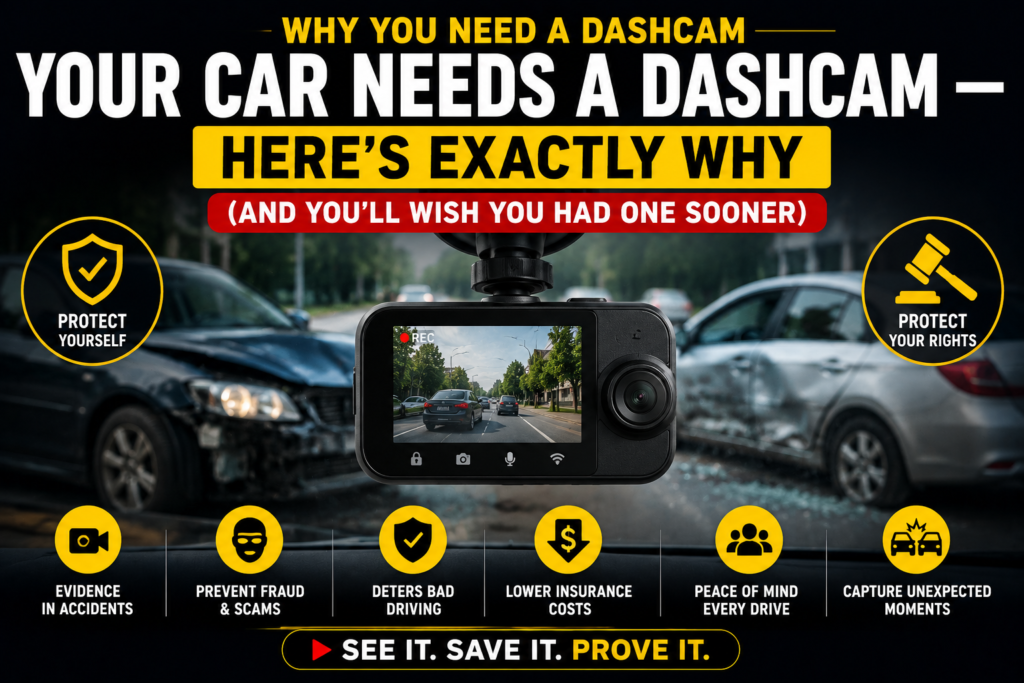
1. On the Road, “He Said, She Said” Decides Everything — Unless You Have Video
When two drivers disagree about what happened in an accident, the outcome almost always comes down to testimony, memory, and whoever tells a more convincing story to an insurance adjuster. Memory is unreliable. Adrenaline distorts perception. And the other driver’s version of events may have nothing to do with what actually happened.
The biggest benefit of owning a dashcam is clear, unbiased evidence. You don’t need to rely on eyewitnesses or uncertain memories. The video shows precise details such as the angle of collision, surrounding traffic, and even weather conditions.
This matters more than people realise. Insurance companies make fault determinations based on the available evidence. Without a dashcam, “available evidence” often means two conflicting accounts and whatever the police report says. With a dashcam, it means a timestamped, GPS-tagged video that shows exactly what happened, in sequence, from the moment before impact. Dashcam footage provides irrefutable evidence for insurance or legal claims, capturing accident details that would otherwise be disputed
The playing field is not level without one. It levels immediately when you have one.
2. Insurance Fraud Is More Common Than You Think — And You’re a Target
This is the uncomfortable reality that the dashcam industry has been highlighting for years, and the numbers back it up entirely. Insurers estimate that between 10% and 20% of all insurance claims are fraudulent, with staged accidents becoming more common and brazen in high-traffic states like California, New York, and Florida. PC Gamer
Staged accidents are not rare edge cases. They are organised, deliberate, and specifically designed to exploit drivers who have no evidence. The common schemes include:
The “Drive Down” — where a fraudster waves you forward at an intersection or parking lot, then accelerates into your vehicle and denies ever signalling you. The “T-Bone Setup” — scammers deliberately crash into your vehicle at an intersection and claim you ran a red light or stop sign, sometimes with fake witnesses backing up their story. The “Fake Pedestrian” — a fraudster pretending to be a pedestrian jumps in front of your car, falsely claiming you struck them.
All of these scams share one critical vulnerability: they fall apart completely when there is video. The dashcam doesn’t just document accidents — it actively deters fraud, because anyone who spots the camera mount on your windscreen immediately knows that whatever they try will be on tape.
Also Read BEST Dashcam for Cars in India
3. Parking Mode Protects Your Car When You Aren’t There
Most people think about dashcams in terms of accidents while driving. But a significant and underappreciated use case is what happens to your car while it’s parked — and you’re nowhere near it.
Motion detection and parking mode allow dashcams to record suspicious activity around a parked car, capturing hit-and-runs or attempted theft even when the vehicle is unattended. In parking mode, the camera draws minimal power from your car’s battery and wakes up automatically when it detects motion or an impact. If someone clips your bumper and drives off, you have their plate. If someone tries to break in, you have their face.
Hit-and-runs in cities like Chicago have spiked by over 60% in recent years, with drivers increasingly leaving the scene of parking lot incidents without leaving contact details. Without parking mode footage, these incidents leave you with a damaged car, no one to hold accountable, and a claim that raises your own insurance rates. With it, you have evidence that shifts the entire situation.
The peace of mind alone — knowing your car is being watched whether you’re in it or not — is something that’s genuinely hard to put a price on once you’ve experienced it.
4. It Protects You From Unfair Insurance Premium Increases
Here’s a financial reality that doesn’t get discussed enough: being wrongly found at-fault for an accident doesn’t just cost you in the short term. It follows your insurance record for years, pushing your premiums higher on every renewal for as long as that claim sits on your history.
A dashcam can protect you from unjustified premium hikes after accidents by providing footage that proves you were not at fault, preventing fraudulent claims from succeeding and encouraging safer driving habits overall.
Dashcam footage can expedite the claims process by preventing drawn-out discussions with insurance companies about who was at fault. The faster a claim resolves in your favour, the less it affects your long-term premium history.
The maths here is straightforward. A mid-range dashcam costs somewhere between $80 and $200. A single at-fault accident that wasn’t actually your fault — with no footage to prove it — can raise your annual premium by hundreds of dollars for three to five years. The dashcam pays for itself the first time you need it. Potentially many times over.
5. Teen Drivers, New Drivers, and Family Cars
If you have a teenager who has just started driving, or if multiple people in your household use the same car, a dashcam serves an additional purpose that parents particularly appreciate: accountability.
Knowing the camera is running encourages better driving habits — smoother braking, more careful lane changes, more attention at junctions. This isn’t surveillance for its own sake. It’s the same reason professional drivers in commercial fleets behave more carefully when they know their vehicle has a camera. The presence of recording equipment shifts behaviour in ways that instruction and lectures simply don’t.
Fleet operators report fewer accidents, faster claims resolution, and even premium reductions of 5–20% after equipping their vehicles with dashcams — largely because driver behaviour improves when accountability is built into the experience.
For a family car used by a new driver, the dashcam also provides something genuinely useful after the fact: a way to review incidents, near-misses, and driving habits together, turning a mistake on the road into a learning conversation rather than an argument about what happened.
6. Legal Protection That Goes Beyond Insurance Claims
Not every incident involving your car ends with an insurance claim. Some end up in court. And in a legal setting, the difference between having dashcam footage and not having it can determine the entire outcome of a case.
Courts and insurance companies routinely accept dashcam footage as reliable evidence to verify accident details, establish fault, and resolve disputes that would otherwise drag on for months.
Beyond accidents, dashcams have been used to document police interactions, record road rage incidents that escalated to threats or physical confrontation, and capture the behaviour of other drivers in ways that directly support legal action. A camera that costs less than a single hour of legal advice can produce the evidence that makes the entire case.
Some authorities now accept dashcam videos as official evidence through dedicated programmes, treating the footage as a legitimate form of witness testimony. The evidentiary value of dashcam footage has only grown as it has become more common, more reliable, and higher resolution
Also Read 70mai vs Qubo – Which One is Right for You?
7. Road Trips, Scenic Drives, and Unexpected Moments Worth Keeping
This is the reason nobody talks about in the practical guides, but it’s real: dashcams capture moments that you would never have thought to film.
A wild animal crossing the road at dawn. A stunning mountain pass on a road trip you’d been planning for years. The moment your child sees the ocean for the first time from the back seat. A sunset you happened to catch on the drive home. A near-miss that became a story you tell for years, with the footage to back it up.
The camera runs continuously in the background, capturing everything. Most of it gets overwritten automatically in loop recording mode. But the moments worth keeping — triggered by impact, saved manually, or flagged by the GPS — stay there. It’s a passive, effortless record of your life on the road that you’ll find yourself grateful for in ways you didn’t anticipate.
8. The Technology Has Caught Up With the Price
Modern dashcams in 2026 are not the grainy, unreliable devices of a decade ago. Even mid-range models now come with features that would have been premium-only a few years back.
High-resolution video, wide-angle lenses, night vision technology, GPS tagging, and cloud storage are now standard features at accessible price points — meaning incidents after dark, peripheral collisions, and location data are all captured reliably without spending a fortune.
Front-and-rear dual camera setups have become the recommended standard, covering both the road ahead and whatever is approaching from behind. Cloud-backup dashcams address the older weakness of SD card corruption by uploading footage automatically, so critical evidence can’t be lost to a hardware failure or removed by someone who knows the camera is there.
GPS integration adds a layer of detail that footage alone can’t provide — precise speed, location, and direction of travel at the moment of an incident. This data is increasingly requested by insurance companies and courts as corroborating evidence alongside the video itself.
9. The Psychological Shift That Changes How You Drive
This last benefit is subtle, but real, and you notice it quickly once the camera is installed: you drive differently when you know everything is being recorded.
Not nervously. Not self-consciously. Just more deliberately. More attentively. You signal more consistently. You leave bigger gaps. You don’t make the questionable overtake. Because somewhere in the back of your mind, you know that if something goes wrong, the video will show exactly what you were doing in the seconds before it happened — and you’d rather that footage show a careful, responsible driver than someone who was pushing their luck.
Dashcams encourage safer driving habits simply by being present — a well-documented effect that commercial fleet operators have relied on for years and that applies equally to individual drivers.
The roads genuinely don’t feel the same after you start driving with a dashcam. You become more aware of the risks around you, more thoughtful about your own behaviour, and more confident about handling the aftermath of an incident if one ever happens. That combination of vigilance and calm is worth a great deal — and it costs less than a tank of petrol to achieve.
What to Look For When You Buy One
If this article has convinced you to finally make the purchase, a few things worth knowing before you browse:
Resolution matters most. Prioritise 1080p minimum; 1440p or 4K is better for capturing licence plates at a distance. Crisp footage that clearly reads a plate in an incident is far more useful than blurry footage that raises more questions than it answers.
Get front and rear. Single-camera setups leave you exposed to rear-end collisions and tailgating incidents. A dual-camera system is the standard recommendation for full protection.
Parking mode is worth hardwiring. A dashcam that draws power from a hardwire kit — rather than the cigarette lighter — can run parking mode indefinitely without draining your battery, using a voltage cutoff to protect the car’s electrics.
Night vision is non-negotiable. A significant proportion of serious incidents happen in low-light conditions. A camera that produces unusable footage at night is only doing half the job.
Consider cloud backup. An SD card can corrupt, fill up, or be deliberately removed. A cloud-connected dashcam uploads critical footage automatically, putting the evidence somewhere the camera itself can’t be tampered with.
The Bottom Line
A dashcam is not an accessory for paranoid drivers or tech enthusiasts. It is, at this point, simply a sensible piece of equipment for anyone who drives regularly — in the same category as good tyres and a functioning spare.
The odds of being in an accident, witnessing a hit-and-run, encountering a fraudulent claim, or coming back to a damaged car with no note are not remote. They happen to ordinary drivers in ordinary situations, constantly. The only variable is whether you have evidence when it does.
For less than the cost of a single insurance excess, you can ensure that the next time something happens on the road, you don’t have to rely on your word against theirs. You have the tape. And the tape doesn’t forget, doesn’t exaggerate, and doesn’t have a reason to lie.
Get the dashcam.