
Stop Guessing. Here’s What the Numbers Actually Say.
Walk into any electronics store and you’ll find charging accessories across three very different shelves — cables promising 40W, MagSafe pucks with Apple’s premium price tag, and Qi pads that look barely different from what launched five years ago. The marketing on all of them sounds fast. The logos on the boxes are confident. But when you actually need your phone at 20% before walking out the door, only one of them is going to save you.
In 2026, the charging landscape has genuinely evolved. MagSafe pushed its ceiling. Qi2 matured. Wired charging on new iPhones got a serious upgrade. So instead of recycling the same generic comparison you’ve read a hundred times, let’s actually dig into what’s changed, what the numbers mean in real life, and which method deserves a place on your desk.
First, Let’s Agree on What “Fast” Actually Means
Wattage is the unit everyone throws around, but watts alone don’t tell the whole story. A charger that claims 65W means nothing if your phone’s battery management steps it down to 15W because it’s warm. A wireless pad rated at 15W will never actually deliver 15W if your phone is even slightly off-centre.
What matters is the real-world rate at which electrons reach your battery. And that’s determined by three things working in concert: the charger’s output, your phone’s input ceiling, and how efficiently the energy transfers between them. Keep that in mind as we go through each method.
Wired Charging: Still the King, and Getting Faster
Let’s get the obvious out of the way: wired charging is the fastest of the three. It always has been, and the gap hasn’t closed as much as the wireless industry would like you to believe.
The iPhone 17, iPhone 17 Pro, and iPhone 17 Pro Max now support up to 40W wired charging over USB-C. With the right charger and cable, these models can reach 50% charge in about 20 minutes — a meaningful jump over previous generations. That’s a significant upgrade over the 20W ceiling that iPhone users had been sitting at since iPhone 12.
On the Android side, the numbers get even more dramatic. The OnePlus 15 tops the fastest-charging charts with 100W wired speeds, achieving a full charge in roughly 45 minutes in real-world tests. The Moto G Stylus 5G (2025) charges at 68W wired, hitting 90% in just 30 minutes and completing a full 0-to-100% cycle in 40 minutes — impressive for a mid-range phone.
The reason wired charging wins so decisively is simple physics. There’s no conversion step. Energy flows directly from the adapter through the cable into the battery, with minimal waste as heat. Wireless charging, by contrast, involves converting electrical energy into a magnetic field and then back into electrical energy — and every conversion step loses something.
The one caveat worth knowing: longer cables directly impact charging efficiency. At 3 metres, even a high-quality cable can lose enough voltage to throttle charging speed noticeably. If you’re charging from your bedside with a 3-metre cable and wondering why it’s slow, that’s probably why.
Also check out BEST Type C Adapter for iPhone in India
MagSafe: The Premium Middle Ground That Got Meaningfully Better
MagSafe is the most misunderstood of the three. People either overpay expecting it to match wired speeds, or dismiss it as an overpriced Qi pad. The truth sits somewhere more interesting.
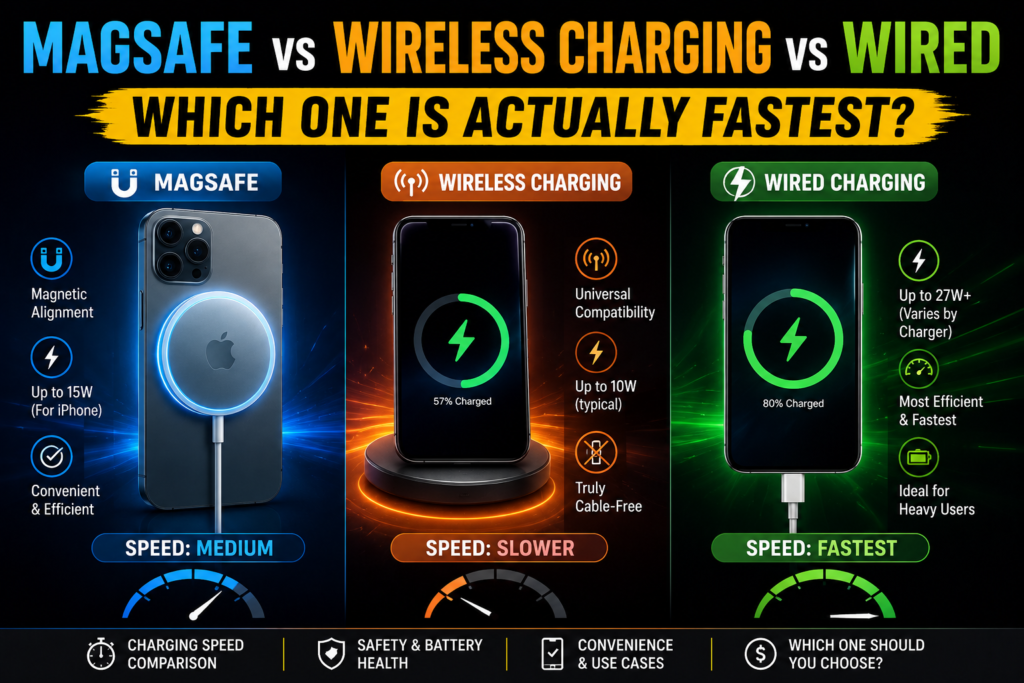
MagSafe delivers faster charging speeds than traditional wireless charging, with iPhone 12 and later models supporting up to 15W. The magnetic alignment ensures the optimal charging position for maximum power transfer — something standard Qi pads cannot guarantee.
But here’s what’s changed in 2026: Qi2 has raised the wireless ceiling. While early Qi2 chargers were capped at 15W, the newer Qi2 25W standard is what to look for if you have a 2025 or 2026 iPhone model — making wireless charging nearly as fast as a standard wired connection for many use cases.
Apple’s own testing with iPhone 17 models used both 40W wired charging and MagSafe chargers with the 30W USB-C power adapter, confirming MagSafe as the intended everyday charger for iPhone 17 users.
The magnetic alignment is genuinely significant — not just a marketing angle. An iPhone will draw a maximum of 7.5W from a standard Qi charger, compared to up to 15W from MagSafe. That means MagSafe can charge your device up to twice as fast as a basic Qi pad — a real advantage when you need a quick power boost.
The downside that rarely gets enough attention: wireless charging runs warmer than wired charging. During long sessions, heat can trigger slower charging speeds and may not be ideal for battery health over time. More on that shortly. Anker
Standard Qi Wireless Charging: Convenient, But Know Its Limits
Generic Qi wireless charging — the kind built into most Android phones and supported on every iPhone since iPhone 8 — is the most universally available of the three methods. Nearly every modern phone supports it. Nearly every hotel bedside table, coffee shop, and airport lounge now has a Qi pad somewhere.
But it’s also the slowest of the three, and the gap with MagSafe is not small.
Standard wireless charging typically offers slower speeds compared to MagSafe. Misalignments between the charging pad and the device’s receiver coil can lead to inefficient power transfer and noticeably decreased charging rates. This is the friction that Qi2’s magnetic alignment was specifically designed to solve.
That said, Qi wireless charging has a role that’s often overlooked: passive top-ups. If your phone sits on a pad for three hours while you work, the fact that it’s charging at 7.5W instead of 15W matters very little. You’ll leave with a full battery either way. The speed disadvantage only really bites when you’re in a hurry.
The Battery Health Question Nobody Answers Honestly
Fast charging is fast because it pushes more current into your battery in less time. That increased current generates heat. And heat is genuinely one of the primary enemies of lithium-ion battery longevity. This isn’t manufacturer fear-mongering — it’s electrochemistry.
If your phone or charging pad gets too warm — crossing around 95°F (35°C) — your iPhone will automatically reduce charging speed to protect the battery and internal components. This is the phone protecting itself. The problem is that it also means your “fast” wireless charger may not be delivering fast speeds in warm conditions.
Wired charging, despite being faster, tends to produce less ambient heat in the phone itself — the bulk of the heat is in the adapter, not the battery. Wireless charging concentrates heat closer to the device.
For long-term battery health, the honest hierarchy is: overnight wired charging at lower wattage (the slowest, coolest option) is best for the battery. Fast wired charging is fine for occasional use. Wireless charging on a pad all night, in a warm bedroom, is probably the least battery-friendly of your regular habits — even if the convenience makes it hard to quit.
Real-World Speed Comparison: A Practical Snapshot
Here’s what the numbers look like in practical terms, focusing on iPhone since that’s where all three methods directly compete:
Wired (iPhone 17 with 40W USB-C): 0 to 50% in approximately 20 minutes. Full charge in roughly 65–75 minutes.
MagSafe / Qi2 at 25W (iPhone 17 with new Qi2 charger): 0 to 50% in approximately 30–35 minutes. Full charge in around 90–100 minutes.
Standard Qi at 7.5W (iPhone on a basic pad): 0 to 50% in approximately 60–70 minutes. Full charge in around 2.5 to 3 hours.
These aren’t lab numbers designed to flatter a product. They’re what you should reasonably expect in normal ambient conditions. If your bedroom runs warm, wireless will be slower. If you’re using an underpowered adapter with your wired cable, wired will be slower too.
The Android Picture Is More Complicated (and More Impressive)
Everything above is primarily an Apple story. On Android, the charging landscape in 2026 is considerably more aggressive — and more fragmented.
The OnePlus 15 supports up to 50W wireless charging with its proprietary AIRVOOC charger — significantly faster than Samsung’s 15W or Apple’s 25W MagSafe limit. A full wireless charge takes under 90 minutes. That’s a wireless charging speed that beats wired charging on most iPhones.
The catch: fast charging remains fully USB-PD compliant on Apple, Samsung, and Google — meaning high-quality third-party chargers from brands like Anker and Ugreen can deliver near-maximum speeds. But proprietary fast-charging standards like SuperVOOC and TurboPower require their own specific chargers to hit peak speeds.
If you’re on Android and want the fastest possible wireless charging, you’re likely locked into a proprietary ecosystem from your phone’s manufacturer. It’s fast, but it means their charger, their cable, their pad.
Which Method Should You Actually Use?
There’s no single correct answer here — but there are correct answers for specific situations.
Use wired charging when: you’re in a hurry. You’re at 15% with 30 minutes before you leave. You’re travelling and bringing a pad isn’t practical. You’re gaming while charging and need sustained power input. Wired is the answer every time speed is the priority.
Use MagSafe or Qi2 when: it’s a casual top-up. You’re sitting at your desk for hours. You’re using your phone as a sat-nav in the car and want it charging on a magnetic mount simultaneously. The convenience-to-speed trade-off makes total sense here, especially now that Qi2 has lifted the ceiling to 25W.
Use standard Qi when: it’s all you have available. It’s overnight charging and speed is irrelevant. You’re on an older phone that doesn’t support MagSafe or Qi2. Don’t write it off — for passive long sessions, it does the job.
The smartest approach in 2026 isn’t choosing one or the other — it’s using each method where it excels. Wireless for convenience at your desk, nightstand, or car mount. Wired for emergency top-ups, travel, gaming, or when battery health matters most.
Also Read How to Fix iPhone Battery Draining Too Fast – Complete Guide
The Gear That Actually Matters
A few things worth knowing before you spend money on a charging upgrade:
For most buyers, the best fast-charging setup is not the absolute highest wattage available — it is the combination that reliably matches your devices, manages heat well, and uses certified cables from reputable brands.
Don’t be blinded by a high wattage number on a box. A “fast” charger that lacks safety certifications or proper thermal management is just a fire hazard in a pretty case. This applies especially to third-party MagSafe-style accessories. Not everything with magnets in it is Qi2 certified, and not every cheap pad will charge your iPhone at the promised speed.
For wired charging, a compact USB-C GaN charger with USB Power Delivery and PPS support, with enough wattage for the largest device you plan to charge, is the best all-around choice. A good 45W GaN charger from a brand like Anker or Ugreen covers virtually any phone you’ll ever own without going overboard.
The Bottom Line
In 2026, wired charging is still the fastest method — and with iPhone 17 now supporting 40W, that gap over wireless has actually widened compared to the iPhone 16 era. MagSafe and Qi2 are the best wireless experience you can get, and the new 25W Qi2 standard is genuinely compelling for everyday use. Standard Qi wireless charging is fine for casual top-ups and overnight charging, and remains the most universally compatible option.
The real answer, though, is that these three methods aren’t competing with each other in your life — they’re complementary. A fast cable at your desk for the days that matter, a MagSafe puck on your nightstand for the nights that don’t, and a Qi pad wherever it happens to be convenient. That’s not hedging. That’s just how modern charging actually works.