
Every few years, TV technology gets a genuine shake-up instead of just a marginally brighter version of last year’s panel. 2026 is one of those years, and the reason is a new kind of backlight called RGB Mini LED. If you’ve been TV shopping recently and noticed unfamiliar names like Micro RGB, True RGB, or RGB MiniLED Evo splashed across Samsung, Sony, Hisense, and TCL’s flagship pages, this is what they’re all talking about, and yes, it’s a genuinely meaningful upgrade, not just another marketing label slapped on the same old panel.
This article breaks down what RGB Mini LED TV technology actually is, how it’s different from the Mini LED TVs you already know, how it stacks up against OLED, and most importantly, whether it’s worth buying into this year or worth waiting on.
What Is RGB Mini LED TV Technology, Exactly?
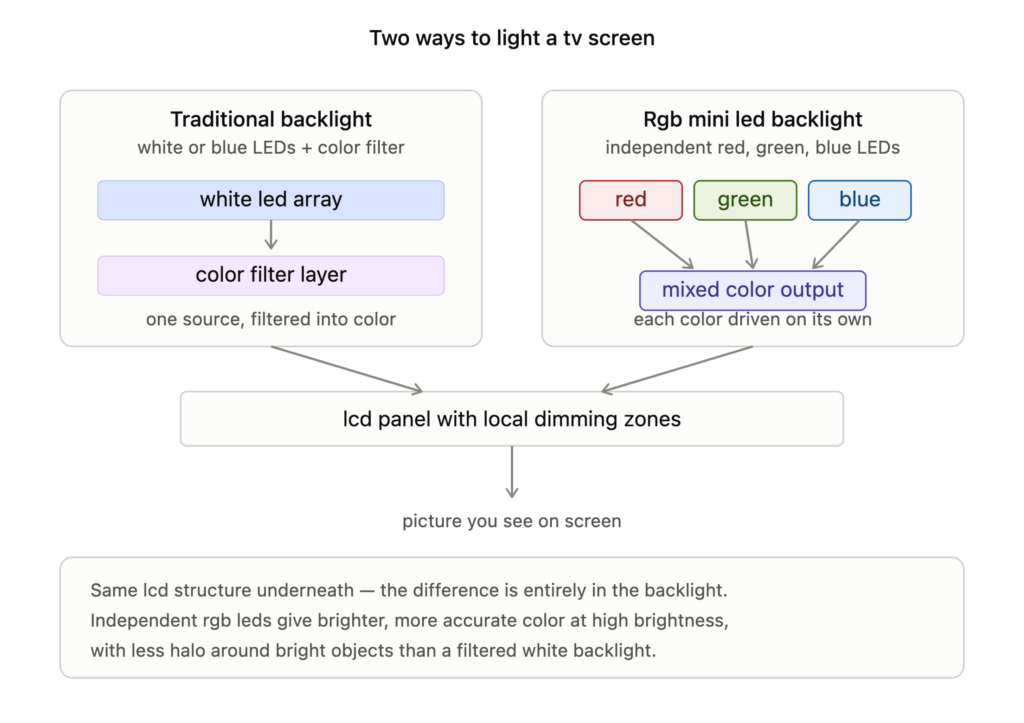
Every LED-backlit TV works by shining light through a panel of liquid crystal pixels, with the backlight itself sitting behind the screen. Until now, that backlight has almost always used either plain white LEDs or blue LEDs paired with a color-converting film to produce the full range of colors you actually see on screen.
RGB Mini LED TVs throw that approach out. Instead of one backlight color doing all the work through a filter, the backlight itself is made up of thousands of individually controlled red, green, and blue LEDs, each one tiny enough to qualify as “mini,” driven independently of one another. Rather than asking a single white light source to fake every color through clever filtering, the TV can simply turn on the exact red, green, and blue light needed for whatever’s happening on screen at that exact moment.
It’s worth being clear about one thing upfront: this is still an LCD technology at its core. RGB Mini LED TVs still use local dimming zones rather than the per-pixel control you get with OLED. The backlight just got dramatically smarter and more colorful, not infinitely precise.
Why Every Major TV Brand Jumped on This at Once
If you’re wondering why this technology seemed to appear out of nowhere with nearly every major brand announcing a version of it within months of each other, the timeline actually makes sense. Hisense was first to bring a consumer RGB backlit TV to market, and once the early results proved the underlying approach genuinely improved color and brightness without the downsides of OLED, the rest of the industry moved fast.
By the most recent major tech trade show of the year, Samsung, Sony, Hisense, and TCL had all either launched or confirmed RGB-based Mini LED lineups, each one wrapped in its own brand name. Samsung calls its version Micro RGB. Sony is calling its take True RGB. Hisense sticks with the more literal RGB MiniLED, and has already pushed a second-generation “Evo” version at the flagship tier. TCL has its own RM-series RGB models, though the company is simultaneously pushing an alternative “Super Quantum Dot” approach on some of its other 2026 sets.
That naming difference matters more than it might seem. The underlying technology across all these brands is fundamentally similar, but the marketing names are not standardized, which means shoppers comparing TVs side by side need to look past the brand label and check the actual backlight specification to know what they’re really buying.
Read more BEST 55 Inch Smart QLED TV in India
RGB Mini LED vs Regular Mini LED: What Actually Changed
If you bought a Mini LED TV in the last couple of years, you already have local dimming zones and a brighter picture than a standard LED set. So what’s the real upgrade here?
The honest answer is color accuracy and color volume at high brightness, specifically. Older Mini LED and standard LED backlights tend to wash toward white as brightness increases, which is part of why a sunset or a neon sign in HDR content can look slightly less vivid the brighter the scene gets. Because RGB Mini LED controls each primary color independently rather than filtering one source through everything, it can maintain saturated, accurate color even at very high brightness levels.
There’s a second, quieter benefit too. Traditional Mini LED panels are well known for a visual artifact called blooming or haloing, where a bright object against a dark background creates a faint glow around it because the backlight zone can’t be precise enough. RGB Mini LED doesn’t eliminate this completely, since it’s still zone-based rather than per-pixel, but the added color precision does meaningfully reduce how noticeable that halo effect is in practice.
RGB Mini LED vs OLED: The Comparison Everyone Actually Wants
This is the question most people searching for this topic actually care about, and the honest answer is that neither technology wins outright. They solve the same goal, a better picture, through opposite engineering approaches.
OLED panels are self-emissive, meaning every single pixel produces its own light and can switch off completely to produce a true, perfect black. That gives OLED an advantage in contrast and viewing angles that RGB Mini LED, still being an LCD-based technology underneath, cannot fully replicate.
RGB Mini LED counters with two specific strengths that matter for a lot of households. First, it can get significantly brighter than OLED panels, which makes a real difference in rooms with windows, daytime sports watching, or any space that isn’t kept dark. Second, because RGB Mini LED is an LCD-based design lit from behind rather than a self-emissive panel, it carries zero risk of burn-in, the gradual image retention that can affect OLED screens displaying the same static content, like a news ticker or a game’s on-screen scoreboard, for extended periods over time.
Color volume is where RGB Mini LED makes its strongest case. Independent measurements have shown RGB Mini LED panels reaching coverage of around 95 percent of the BT.2020 color gamut, the wide color space used by most current 4K and HDR content, which puts it in genuinely competitive territory with premium OLED panels on color specifically, while still offering the brightness ceiling OLED can’t match.
So which one should you actually buy? It depends entirely on your room and your habits. If you watch primarily in a dark room and care most about deep blacks and movie-night contrast, OLED remains the stronger choice. If you’re watching in a bright living room, you care about sports, you game with a fixed HUD on screen for hours at a time, or you simply want the most vivid, punchy color possible without worrying about burn-in down the line, RGB Mini LED is a genuinely strong, increasingly mainstream alternative.
Which Brands and Models Are Actually Available
As of 2026, RGB Mini LED technology has expanded well beyond the expensive, oversized first attempts that defined its debut. Here’s where things stand brand by brand:
Samsung’s Micro RGB lineup now spans two series, the flagship and a step-down model, available across a much wider range of sizes than its original single oversized launch model, making the technology realistically shoppable for normal living rooms rather than just dedicated home theater rooms.
Sony has branded its version True RGB and positioned it as a genuine flagship-tier picture technology going forward, emphasizing wide color gamut and consistent color accuracy across viewing angles.
Hisense, having brought the very first consumer RGB-backlit TV to market, has continued pushing the technology fastest and widest, now offering it across multiple series at multiple price points and screen sizes, making Hisense arguably the most accessible entry point into this technology for budget-conscious buyers in 2026.
TCL offers RGB Mini LED in select series as well, though the company is simultaneously promoting an alternative quantum-dot-based approach on some of its other flagship sets, so it’s worth checking the specific model name carefully if TCL is on your shortlist.
LG, notably, has continued positioning OLED as its flagship technology rather than leading with RGB Mini LED, which is a useful signal in itself about how the industry still views the two technologies relative to each other at the very top end.
Common Questions About RGB Mini LED TVs
Is RGB Mini LED the same as Micro RGB?
Not exactly. Micro RGB is Samsung’s specific brand name for its version of the technology, built using extremely small LED emitters. RGB Mini LED is the more general term used across the industry, including by Hisense, Sony, and TCL, and the underlying engineering varies slightly by brand even though the core concept, independently controlled red, green, and blue backlight LEDs, is the same.
Does RGB Mini LED suffer from burn-in like OLED?
No. Burn-in is a risk specific to self-emissive panels like OLED, where individual pixels can age unevenly over time from displaying the same static content repeatedly. RGB Mini LED is an LCD technology lit from behind, so static elements like channel logos or game HUDs pose no burn-in risk at all.
Is RGB Mini LED worth buying over a regular Mini LED TV?
If color accuracy, HDR highlight quality, and reduced blooming around bright objects matter to you, yes, it’s a meaningful step up. If you’re on a tighter budget and mainly watch standard content without much HDR, a well-reviewed standard Mini LED TV will still look excellent for considerably less money.
Will RGB Mini LED TVs get cheaper?
Almost certainly. The first RGB-backlit TVs launched at extremely high prices in oversized screen sizes. Within about a year, the same core technology had already expanded into far more mainstream sizes and a wider range of price points across multiple brands, which is the typical pattern for any new display technology as manufacturing scales up.
Should I buy RGB Mini LED or wait for next year’s models?
If you need a TV now and the size and price fit your budget, current RGB Mini LED models are mature enough to buy with confidence rather than treating them as risky first-generation tech. If you’re not in a rush, prices typically drop and size options typically expand the longer any new display technology has been on the market, so waiting another cycle is a reasonable choice too.
The Bottom Line
RGB Mini LED isn’t a marketing buzzword dressed up to look like progress, it’s a real change in how the backlight behind your TV screen produces color, and it’s the single biggest shift in mainstream TV technology this year. It won’t replace OLED at the very top of the market, since true self-emissive contrast is still OLED’s strength alone, but for color accuracy, brightness, and complete freedom from burn-in worries, RGB Mini LED has very quickly gone from an expensive experiment to a genuinely mainstream, shoppable option across nearly every major TV brand.
If you’re upgrading a TV this year and want the best possible color and HDR performance for a bright living room without paying OLED prices or worrying about burn-in, this is the technology category worth shortlisting first. [LINK: check out our TV panel comparison guide] if you want to see how RGB Mini LED stacks up directly against the other panel types currently on the market before you decide.