
128GB vs 256GB vs 512GB phone storage — which one should you choose? Find out the best option for your needs, usage, and future-proofing.
The Question That Costs People More Than They Realise
Every time a new phone launches, the same debate starts up in the comments. Is 128GB still enough? Should I just jump to 256GB to be safe? Is 512GB overkill or am I going to regret not getting it in two years?
It sounds like a minor decision. But get it wrong and you’re living with a phone that constantly nags you to delete photos, refuses to download apps, or kills off a WhatsApp backup because there’s simply no room. And unlike RAM or a slow processor — which you can mentally tolerate — running out of storage stops your phone working in the most literal, frustrating way possible.
Here’s the thing: figuring out how much phone storage you actually need isn’t complicated. It just requires being honest about how you actually use your phone — not how you think you use it.
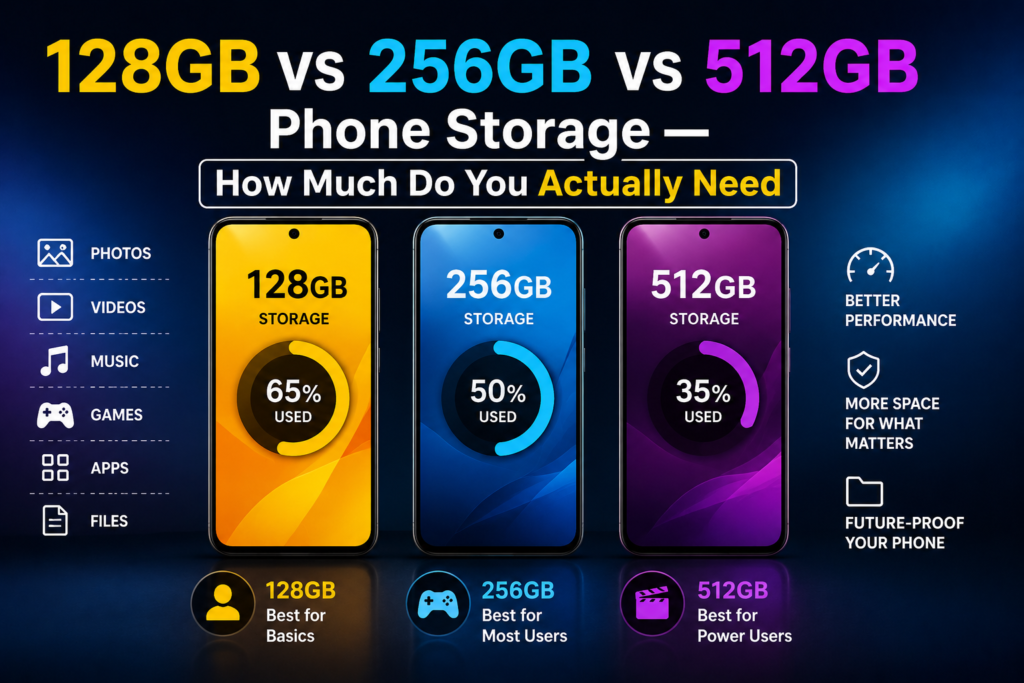
Before You Pick a Number, Understand What Eats Your Storage
Most people dramatically underestimate how much storage they use because they only think about the obvious things — photos and apps. The reality is messier.
Here’s what’s quietly filling your phone right now:
The operating system and pre-installed apps take up more than most people expect — typically between 10GB and 20GB before you even open the box. A 128GB phone doesn’t give you 128GB. It gives you closer to 110GB of actual usable space from day one.
Photos and videos are the biggest wildcard. A single minute of 4K video at 60fps on an iPhone 17 Pro eats around 400–500MB. Shoot ten minutes of your kid’s football match and you’ve used 4–5GB without thinking about it. Casual shooters don’t notice. People who actually document their lives feel it constantly.
WhatsApp and Telegram media is the silent killer that nobody talks about. Years of group chats — voice notes, photos from other people, videos auto-downloading at 2am — can quietly accumulate to 20, 30, even 50GB over time. Most people don’t discover this until their storage is already gone.
Games have been creeping upward in size for years. A single premium mobile game now routinely demands 3–6GB, sometimes more. If you play even two or three regularly, you’re looking at 10–20GB committed to gaming alone.
Offline downloads — Spotify playlists, Netflix episodes, YouTube videos, podcasts — add up fast for commuters and frequent travellers who download content for offline use.
AI features are the newest and most underappreciated storage hog. On-device AI models — the kind that power Apple Intelligence, Google Gemini on-device, and Samsung’s Galaxy AI — require local processing files that can take up 40–60GB of system storage. This is a 2026 reality that simply didn’t exist two years ago. It changes the math on 128GB significantly.
What 128GB Actually Gets You in 2026
Let’s be direct: 128GB is the base tier, and it is increasingly the tier people regret.
It’s not that 128GB is objectively small. By any historical measure, it’s plenty of space. But phones and the software running on them have got considerably heavier. The operating system is bigger. Apps are bigger. Camera files are bigger. And AI features are eating into available storage in ways that simply weren’t a factor even two years ago.
In practical terms, a 128GB phone — after the OS and pre-installed apps — leaves you with roughly 100GB of real working space. If you’re a cloud-first user who backs everything up automatically, clears WhatsApp media regularly, doesn’t hoard offline downloads, and doesn’t game heavily, 128GB can absolutely work. It requires discipline, though. You will get the low storage warning. You will occasionally have to delete things before you can take a photo.
128GB makes sense for you if:
- You back up photos automatically to Google Photos or iCloud and delete local copies
- You don’t shoot much video, or you transfer it to a computer regularly
- You use streaming for music and video rather than downloading offline
- You play light mobile games, not heavy ones
- You’re genuinely minimalist about what stays on your phone
128GB will frustrate you if:
- You never think about storage until it’s already full
- You shoot a lot of video, especially in 4K
- You’re in multiple active WhatsApp groups with media auto-download on
- You want AI features to work properly without throttling
- You plan to keep this phone for three years or more
The honest summary: 128GB is survivable for light users in 2026. It is not comfortable for average users, and it is genuinely inadequate for heavy users.
Also Read Best microSD Card for Dashcam — Don’t Buy the Wrong One
What 256GB Gets You — The Sweet Spot That Actually Earns That Label
256GB is where the market has quietly settled as the real baseline for most people, and in 2026 that shift is more justified than ever.
After the OS and system files, you’re working with around 230GB of usable space. That’s enough headroom for most people to never think about storage — which is the actual goal. You want a phone that lets you take photos, download games, update apps, and enable AI features without constantly managing a digital filing cabinet.
256GB handles everything a typical user does without compromise. A large photo library. Several offline playlists. Four or five heavy games. Years of WhatsApp media without obsessive clearing. Video recording without checking your remaining storage first. AI features running locally without eating half your available space.
It’s also the tier where the price-to-capacity ratio is most sensible. The jump from 128GB to 256GB is typically around ₹5,000–₹8,000 or $30–$50 depending on the phone. Spread across the two to three years you’ll own the phone, that’s a negligible daily cost to avoid constant storage anxiety.
256GB is the right choice for:
- Most people — genuinely, the majority of smartphone users
- Anyone who doesn’t want to actively manage their storage
- Regular photographers and casual video shooters
- People who use cloud backup but also like having things locally
- Anyone enabling on-device AI features
- People keeping the phone for 2–3 years
What 512GB Gets You — and Who Actually Needs It
512GB is not overkill for everyone. It’s overkill for most people — but for a specific kind of user, it’s the only tier that makes sense.
The clearest use cases: you shoot a lot of high-resolution video and don’t transfer it to a computer after every session. You travel frequently and download substantial amounts of content for offline use. You maintain a large local music library in lossless quality. You play multiple heavy games simultaneously. You’re a content creator whose phone is genuinely a production tool.
If any of those describe you, 512GB will feel immediately justified. You will never see a low storage warning. You will never make the “which photo should I delete” decision. Your phone will feel unconstrained in a way that’s genuinely satisfying.
For everyone else, it’s a premium you’re paying for peace of mind rather than necessity — which isn’t irrational, but it’s worth being clear-eyed about.
One thing that does shift the calculus: how long you’re planning to keep the phone. If your upgrade cycle is two years, 256GB is almost certainly fine. If you’re the type who uses a phone for four or five years and rarely upgrades, 512GB becomes a more defensible insurance policy. Storage needs only move in one direction over time.
512GB makes sense if:
- You record a lot of 4K or ProRes video regularly
- You’re a content creator using your phone as a primary camera
- You download large volumes of content for offline use
- You keep a large lossless music library on-device
- You play five or more heavy games simultaneously
- You’re keeping this phone for four years or more
Also Read MacBook Overheating After Update? Fix It Fast
The AI Storage Problem Nobody Is Talking About Enough
This deserves its own section because it genuinely changes the storage conversation in 2026.
On-device AI — Apple Intelligence, Gemini Nano, Galaxy AI running locally — requires storing large language model files directly on your phone. These models need 40–60GB of system storage to run properly. This isn’t optional space you can reclaim. It’s infrastructure.
On a 128GB phone, that’s potentially half of your usable storage committed to AI features before you’ve taken a single photo. On a 256GB phone, it’s a meaningful chunk but leaves you with plenty of room. On a 512GB phone, you’ll never notice it.
This is the single biggest reason the storage conversation has shifted in 2026 compared to even two years ago. The phone that felt comfortable at 128GB in 2023 is the phone that feels genuinely tight in 2026 — and AI features are a large part of why.
A Quick Reality Check: What Does Your Current Phone Tell You?
Before deciding on storage for your next phone, check your current usage. It’s the most accurate predictor you have.
On iPhone: go to Settings → General → iPhone Storage. On Android: go to Settings → Storage. Look at your current usage number — not just the total, but the breakdown. How much is photos? How much is apps? How much is WhatsApp or other messaging apps?
Now add 20–30% to that number to account for growth over the next two years. That’s roughly the storage tier you should be targeting — not the one that barely fits what you have today.
The Verdict: Which Storage Should You Actually Buy?
Buy 128GB if you genuinely use cloud backup religiously, shoot minimal video, don’t game heavily, and are confident you’ll keep your storage habits disciplined. You’ll manage — but you will need to manage.
Buy 256GB if you’re a normal human being who doesn’t want to think about storage. This is the right answer for the overwhelming majority of people buying a phone in 2026. It covers current needs, handles AI features, and leaves enough headroom to last through a full two-to-three year ownership cycle without ever feeling squeezed.
Buy 512GB if video is a big part of your phone life, you’re a power user or content creator, you keep phones for a long time, or you simply want to buy it once and never think about storage again. It’s not necessary for most people — but for the right person, it’s completely worth it.
The most common regret in the phone storage decision isn’t buying too much. It’s buying too little. Storage is the one thing you cannot upgrade after purchase. If you’re genuinely torn between two tiers, the tier up is almost always the smarter long-term call.
Frequently Asked Questions: 128GB vs 256GB vs 512GB phone storage
Is 128GB enough for an iPhone in 2026? It can be, but only if you use iCloud aggressively and manage your storage actively. For most iPhone users, 256GB is the safer and more practical choice in 2026, especially with Apple Intelligence requiring significant on-device storage.
Is 256GB future-proof for 3 years? For most average users, yes. 256GB should comfortably last a standard 2–3 year phone ownership cycle without feeling constrained, particularly if you use some cloud backup alongside local storage.
Is 512GB overkill for the average user? For the average user, yes — 256GB is sufficient. 512GB earns its cost for content creators, heavy video shooters, offline media hoarders, and people who keep phones for 4+ years.
What uses the most storage on a phone? In 2026, the biggest storage consumers are: 4K video, WhatsApp and Telegram media accumulation, heavy games, lossless music libraries, offline downloads, and on-device AI model files.
Can you add storage to a phone later? On most modern flagship phones — including all iPhones and most Samsung Galaxy models — no. Storage is fixed at purchase. This is exactly why it’s worth spending a few extra thousand rupees or dollars to get the tier above what you think you need.