
Voltas AC not cooling is one of the most common appliance complaints in India every summer, and if you are reading this with a running AC that is blowing warm or barely cool air into a hot room, you are not alone. Voltas is India’s number one selling AC brand, which means it also has more units in homes across the country than any other brand — and more units means more people running into the same predictable set of problems every season.
The good news is that the majority of Voltas AC cooling failures are caused by a small, well-understood list of issues, and several of them are genuinely fixable at home without calling a technician. This guide walks through every real cause in order — starting with the simplest checks and moving toward the more serious hardware issues — so you can find your actual problem without guessing.
Table of Contents
Before Anything Else: One Important Caution
If your Voltas AC is not cooling and you are tempted to switch it off and on repeatedly trying to make it work, stop doing that. Repeated switching on and off when the AC is struggling can damage the compressor. Switch the unit off properly, leave it off for at least 10 minutes, and then work through the checks below before turning it on again.
Cause 1: Dirty or Clogged Air Filter — Check This First, Every Time
If your Voltas AC is not cooling properly, the air filter may be clogged with dust. A blocked filter restricts airflow, reducing cooling efficiency and increasing power consumption.
This is the most common cause of reduced Voltas AC cooling, and it is also the most overlooked because it happens gradually. The filter gets dirtier every day and the cooling gets slightly worse every week, so most people don’t notice until the room simply isn’t getting cool anymore.
In Indian conditions specifically — dust, pollution, and high humidity across most of the country — filters get dirty faster than the standard “clean every two weeks” advice suggests. If you live in a dusty city, near construction, or in an area with high pollution levels, your Voltas AC filter may need cleaning every 10 to 14 days during heavy summer use, not the 30-day interval many people default to.
How to check and clean it:
Open the front panel of the indoor unit — on most Voltas split ACs, press the two side clips on the front grille and lift it up. The filter is the mesh panel directly behind it. Pull it out gently. If it is visibly grey, furry with dust, or you can see light barely passing through it when you hold it up, it needs cleaning immediately.
Rinse the filter under running water, use a soft brush if the dust is caked on, and let it dry completely in the shade before reinserting it. Never use a wet filter. If the filter is torn or warped, replace it — Voltas replacement filters are available online and at service centres for ₹200 to ₹500 depending on the model.
After cleaning: Run the AC for 30 minutes and check whether cooling has improved before moving on to the next cause.
Cause 2: Wrong Mode or Temperature Setting
This sounds too simple, but it causes a surprising number of “Voltas AC not cooling” complaints, particularly after a power cut or when someone else has used the remote.
Check these settings in order:
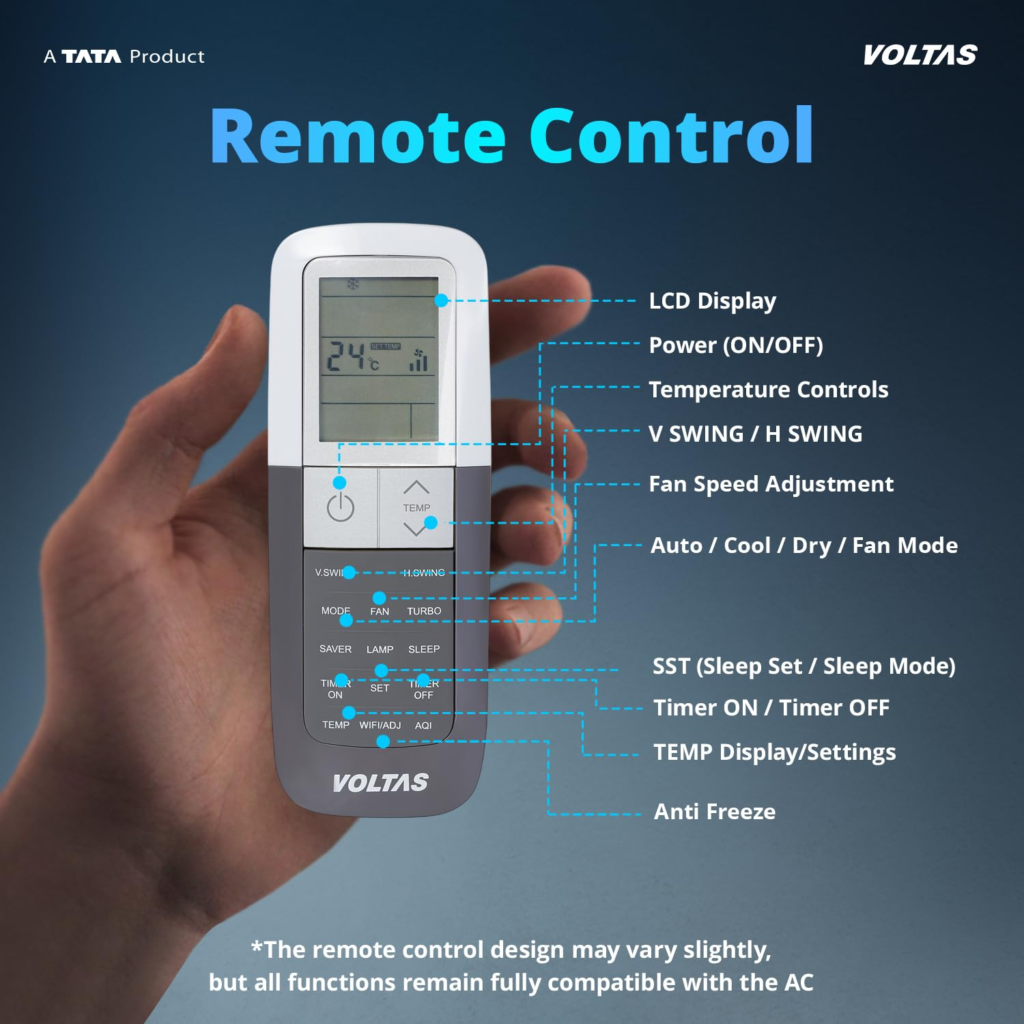
Confirm the unit is set to Cool mode — not Fan mode, Dry mode, or Auto mode that is running fan-only. On the Voltas remote, the mode button cycles through Cool, Dry, Fan, and Auto. The display should show a snowflake icon for Cool mode.
Confirm the set temperature is below the current room temperature. If the room is 32°C and your AC is set to 32°C or higher, the unit will simply not activate the compressor since it has already reached the target. Set it to at least 5°C below the current room temperature during initial cooling.
If there was a recent power cut, some Voltas models reset to a default mode or temperature that may be different from your last setting. Check the remote display and reapply your preferred settings.
Cause 3: Dirty Outdoor Unit and Condenser Coils
If the condenser coils are dirty and loaded with debris, the AC’s cooling efficiency drops significantly. The condenser coil must be clean to dissipate heat outside. As the coils get dirtier the AC becomes less efficient, which makes it work harder to cool the room.
The outdoor unit of your Voltas split AC is exposed to dust, rain, leaves, bird droppings, and whatever else the environment brings. Its job is to release the heat extracted from your room into the outside air, and when the coils are coated in grime, that heat transfer becomes less and less efficient. The result is that your AC runs continuously, consumes more electricity, and still fails to cool the room adequately.
You can check the outdoor unit yourself by looking at the fins on the back and sides — if they look grey or brown rather than the original metallic colour, they need cleaning.
For basic outer surface cleaning: Turn off the AC completely at the switch and the isolator. Use a garden hose at low pressure to gently rinse the fins from the outside. Do not use a high-pressure jet — this can bend the thin aluminium fins and reduce airflow further.
For a thorough internal coil clean: This is best done during your annual service. A technician will use a coil cleaning solution and rinse out the fins from the inside, which is significantly more effective than an external rinse. Most Voltas authorised service visits include this as part of a standard service.
LG Air Conditioner Problems: Every Common Issue, Fix, and Error Code Explained
Cause 4: Voltas AC Blowing Air But Not Cooling — Low Refrigerant Gas
Refrigerant gas is the core element responsible for cooling. If there is a leak or the gas level is low, your Voltas AC will blow air but not cool effectively.
This is one of the most important things to understand about refrigerant: AC gas does not get consumed. If gas is low, there is almost always a leak that must be fixed. An AC that is low on refrigerant has a leak somewhere — at a joint in the copper pipe, at the indoor or outdoor unit connection, or in the coil itself. Simply refilling the gas without locating and fixing the leak is a waste of money. The gas will leak out again within weeks or months and the problem will return.
Signs your Voltas AC has a refrigerant leak:
- The AC runs continuously but the room never reaches the set temperature
- Ice forming on the copper pipe near the outdoor unit or on the indoor unit’s coil
- A hissing sound near the indoor or outdoor unit
- Higher electricity bills with less cooling than before
- The outdoor unit’s compressor is running but the indoor air is barely cool
What to do: This is not a DIY repair. Handling refrigerant requires certification and specialist equipment. Call Voltas authorised service (1800-419-1999, toll free) and specifically ask for a gas leak check before any refill. A reputable technician will pressure-test the system first, identify and repair the leak, and then recharge the refrigerant to the correct level. Expect to pay ₹1,500 to ₹3,500 for a gas leak check and refill depending on your location and the AC capacity.
Best 1.5 Ton Split AC In India
Cause 5: Frozen Evaporator Coil
If your Voltas AC indoor unit is blowing little to no air and the unit feels unusually cold on the outside, the evaporator coil inside it may have frozen solid. This sounds like a contradiction — the cooling coil is frozen, but the room isn’t cold — but it is actually a direct result of restricted airflow.
When the filter is severely clogged or the airflow is blocked, the coil gets too cold because the air that normally carries heat away from it isn’t flowing. The moisture in the air freezes on the coil, forms a layer of ice, and eventually blocks all airflow completely.
How to fix it:
Switch the AC off completely and set it to Fan-only mode. Leave it running on fan for 1 to 2 hours to allow the ice to melt naturally. Place a towel under the indoor unit to catch the drip. Do not use a hairdryer or any external heat source to speed this up.
Once defrosted, clean the air filter thoroughly before switching back to Cool mode. If the coil freezes again within days of cleaning the filter, the issue may be low refrigerant rather than airflow restriction, and a technician needs to check the system.
Cause 6: Outdoor Unit Not Running
Sometimes the Voltas AC indoor unit runs normally — fan is blowing, display is working — but the outdoor unit is completely silent. In this case, the indoor unit is just circulating room-temperature air, which explains why nothing is getting cool.
Check these things before calling a technician:
Is the outdoor unit’s circuit breaker tripped? Many installations have a separate isolator switch near the outdoor unit. Check that it is in the On position.
Is the outdoor unit overheating? An AC has an optimum operating temperature at which it can work most effectively. If the temperature outside shoots up beyond the optimum limit, the efficiency drops significantly. Most Voltas split ACs are rated to operate up to 48°C to 52°C outdoor temperature. On extreme summer days when outdoor temperature crosses 48°C in North India, the outdoor unit may trip its thermal protection and switch off automatically. If this is happening consistently on the hottest days, the outdoor unit may need to be repositioned to a shadier location, or a shade cover installed above it (but never blocking the fan outlet on top).
Is the outdoor unit completely blocked? The outdoor unit needs clear airflow on all sides. If it has been boxed in by walls, covered, or has debris accumulated against the fins, this causes overheating and compressor shutdown.
Cause 7: Faulty Thermostat or Temperature Sensor
A thermostat is a sensor that senses the room temperature and signals the compressor to start or stop the cooling cycle. If the thermostat is defective, the AC does not cool or may cool continuously.
On Voltas split AC units, the room temperature sensor is typically a small thermistor located near the return air vent on the indoor unit. If this sensor fails or develops a fault, it can give the control board an incorrect reading of the room temperature, causing the compressor to not activate even when the room is hot.
A failed temperature sensor often comes with a specific error code on the display. On most Voltas models, a flashing display or an error code starting with “F” or “E” points toward a sensor fault. Check the error codes section below for specifics.
A technician can test the sensor with a multimeter in about five minutes. Replacement sensors typically cost ₹200 to ₹600 and the repair is straightforward.
Daikin Air Conditioner Problems: Every Common Issue, Fix, and Error Code Explained
Cause 8: Compressor Failure
The compressor is the heart of an AC unit which is responsible for cooling your room. If the compressor is defective, the cooling cycle does not start and the AC fails to cool.
Compressor failure is the most serious and most expensive Voltas AC problem. Signs of compressor failure: the outdoor unit fan runs but the compressor makes no sound at all, or the compressor makes a clicking or grinding sound and immediately shuts off, or the AC ran fine for years and then stopped cooling completely without any of the gradual decline associated with dirty coils or gas leaks.
Voltas provides a 5-year warranty on the compressor across most of their split AC models. If your unit is within this period, contact Voltas authorised service before arranging any third-party repair — compressor replacement under warranty costs you only the service visit charge, not the compressor itself. Out of warranty, compressor replacement runs ₹4,000 to ₹12,000 depending on the capacity and model.
Voltas AC Error Codes Related to Cooling Problems
Most current Voltas split AC models display error codes when a fault is detected. Here are the codes most directly related to cooling failures:
E1 — Indoor room temperature sensor fault. The thermistor reading room temperature has failed. The AC may run but cool inconsistently or not reach the target temperature. Fix: Reset the unit first (power off for 5 minutes). If code returns, the sensor needs replacement.
E2 — Indoor coil temperature sensor fault. Same approach as E1 — reset first, replace sensor if code returns.
E3 — Outdoor temperature sensor fault. Points to the sensor on the outdoor unit. Technician required.
E4 — Compressor discharge temperature protection. The compressor is running too hot, typically from low refrigerant, dirty condenser coils, or blocked outdoor airflow. Clean the outdoor unit and ensure it has adequate clearance. If code persists, call service.
E5 — Overcurrent protection activated. The system drew too much current, usually from a struggling compressor or a voltage issue. Check your home’s power supply voltage first.
E6 — Communication error between indoor and outdoor units. Check that the wiring between the two units is intact and connections are secure. If wiring looks fine, the control board needs professional diagnosis.
F1 / F2 — Sensor-related faults on some models, equivalent to E1/E2 on others. Approach is the same.
For any error code: always try a full power reset first. Switch off at the remote, then at the wall switch, then at the main isolator if accessible. Leave off for 5 full minutes before restoring power. Many codes caused by a power surge or temporary fault clear on reset and do not return.
Voltas AC Not Cooling — DIY vs Call a Technician
You can fix this yourself:
- Cleaning the air filter
- Checking and correcting the mode and temperature settings
- Defrosting a frozen coil (switch off, fan mode, wait)
- Checking the outdoor unit isolator switch
- Ensuring the outdoor unit has adequate clearance and airflow
- Power cycling the unit to clear error codes
Call Voltas authorised service:
- Refrigerant gas leak or recharge (illegal to handle without certification, and requires specialist equipment)
- Compressor failure or unusual compressor sounds
- Error codes that return after a full power reset
- Outdoor unit completely silent despite power being present
- Any repair involving opening the indoor or outdoor unit’s sealed refrigerant system
Voltas Customer Care: 1800-419-1999 (Toll Free, 8 AM to 8 PM)
Voltas Service App: The Voltas Service app on Android and iOS allows you to book a service visit, track the technician, and view the service history for your specific unit.
LG 1.5 Ton 5 Star, Smart Inverter Split AC
Preventive Maintenance to Avoid Voltas AC Cooling Problems
The majority of Voltas AC cooling problems are preventable with basic maintenance. Here’s what actually matters:
Every 10 to 14 days during summer use: Clean the air filter. In dusty Indian conditions, this single task prevents the most common cooling failure, higher electricity bills, coil freezing, and poor air quality simultaneously.
Once at the start of every summer season: Book a professional service before the peak heat arrives — ideally March or April before temperatures climb. A thorough service includes coil cleaning, drain line check, refrigerant pressure check, and electrical connection inspection. Do not wait until the AC stops cooling in May to call service — wait times in peak summer can stretch to 5 to 10 days.
Keep the outdoor unit clear: Check every few weeks that nothing has accumulated against the fins, that the fan outlet on top is unobstructed, and that the area around the unit has at least 50cm of clearance on all sides.
Annual refrigerant pressure check: Ask your service technician to check refrigerant pressure at every annual service, not just when you notice a cooling problem. Catching a small leak early prevents the slow degradation of cooling performance that most people attribute to the AC “getting old.”
If you are considering whether a Voltas AC is the right brand for your home or comparing it with other options before your next purchase, [LINK: our Best Air Conditioners in India guide] covers the top-rated models across every major brand currently available. And if you own an LG or Daikin AC and are facing similar cooling issues, [LINK: our LG Air Conditioner Problems guide] and [LINK: our Daikin Air Conditioner Problems guide] follow the same format as this article.
Call Customer care: Tel:1800-419-1999
FAQ
- “Why is my Voltas AC running but not cooling the room?”
- “How do I know if my Voltas AC has a gas leak?”
- “What does E1 error mean on a Voltas AC?”
- “Can I clean my Voltas AC filter myself?”
- “How often should I service my Voltas AC in India?”